Thursday, February 9, 2012

Tips to New Mothers - Part four

baby

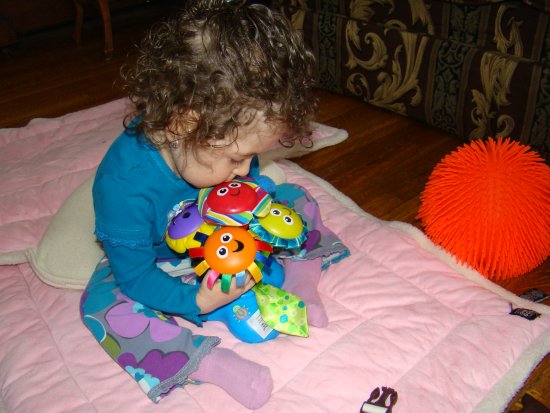
It is for you to stretch his five lively senses from the day 'he lS born. He needs to hear your voice - singing, humming, talking. He should• be exposed to as much variety of sights, sounds and smells as possible; they will make him happier and brighter too. A baby exposed to different environments will meet more germs, but gradually such exposure will help him tolerate them better. The more he's kept in a sterile situation, whether restricted in activities, noise or people, the less stimulated he will not be happier and brighter.

Tips to New Mothers - Part three

New Born Baby

A child goes through many stages. The most dramatic of them occur between birth and one year. Some bring pleasure, others bring pain, but 'every one of them will But remember, your baby is yours alone. Don't let anyone bully you into doing anything you do not want to do. Rely on your instinct (this reaches new heights ), a reliable knowledge of child care and sound advice from those more experienced around yon will also helps you.

Thursday, December 29, 2011

Tips to New Mothers - Part two

Cute Baby and Mother

There is often a vaginal discharge in the first days after birth. It appears as white mucus and may he ting with blood. Sometimes both baby boys and girls develop a swelling and fullness of their breast. They may actually secrete milk, which sometimes even exudes from the nipples. You should not squeeze this milk out deliberately; such squeez¬ing may result in an infection or an abscess. Both vaginal discharge and milk secretion are caused by maternal hormones which crossed the placenta: before birth.

The newborn usually passes urine in the first twelve hours, but delays up to 24 hours are not unusual. If the baby does not pass urine by then, inform your doctor. The baby's bowels usually start functioning in 24 hours. Initially, the child will pass a blackish motion, called meconium. The normal, yellow-colored motion appears only around the third or fourth day of life.

Wednesday, December 14, 2011

Tips to New Mothers - Part one

Baby Photo

The newborn's genitals are usually disproportionately large, being swollen at birth. The swelling will gradually disappear .. In an uncircumcised baby boy, the foreskin normally adheres to his penis and should not be forcibly retracted. The foreskin naturally separates and becomes retractable as the child grows older.

The umbilical cord, which linked Baby to you, is cut and tied immediately after birth. It begins to dry and turn leathery soon afterwards and will fall off within 5-10 days. . A slight bulge around the umbilical cord may sometimes develop in the first month. This too is not uncommon and is not dangerous; it generally disappears by the end of the first year

Sunday, November 27, 2011

Tips to New Mothers

Baby

Many newborns have a variety of "spots" on their skin. Others have dark pigmented areas, usually to be found on their bottoms, backs or feet. These areas are called Mongolian spots; they become lighter as the child grows. Still other babies have red patches, or Hangel's kisses", at the roots of their noses or at the napes of their necks. No treatment is recommended in all these cases, as they will aU eventually disappear.

If you see Sometimes a blister in baby's mouth on its upper lip. Don’t worry. This is due to suckling, particularly in a breast-fed infant. It will disappear by itself. Some infants are born with a tooth. If it is loose, it can be removed easily.

Saturday, November 19, 2011

New Born Babies - Eyes

Baby

The eyelids of the newborn may appear puffy, again due to its forcible passage during labour, but this too will disappear in a day or two. Sometimes the baby's eyelids will be sticky. Nothing more than a little cotton wool is needed to wipe them and remove the stickiness. Almost all newborns, upto the age of six months, have one eye wandering. This is normal and happens only because the baby's muscles have not yet become co¬ordinated. As time goes by, it will Correct itself, so don't fret the first time you notice this and think your child is going to be cross-eyed. The baby's pupils constrict if a torch-light is reflected on them.

Tuesday, November 15, 2011

New Born Babies - Some common doubts

New Born Baby

When the baby is born he is covered with a grayish, somewhat greasy substance. Doctors call it vernix caseosa and it is secreted by the foetus's skin glands. This is Nature's way of protecting the foetus's skin from the effect of the long exposure to the liquid environment found in the uterus. It will come off by itself in a few days. It can also be removed by rubbing oil over the baby. The newborn baby is also covered with fine, scarcely visible hair. This too will soon disappear, usually during the first month. At birth the baby is usually pink all over. But sometimes its hands and feet may be bluish for a few hours.